Média
Embassy in Hungary, Washington D.C.
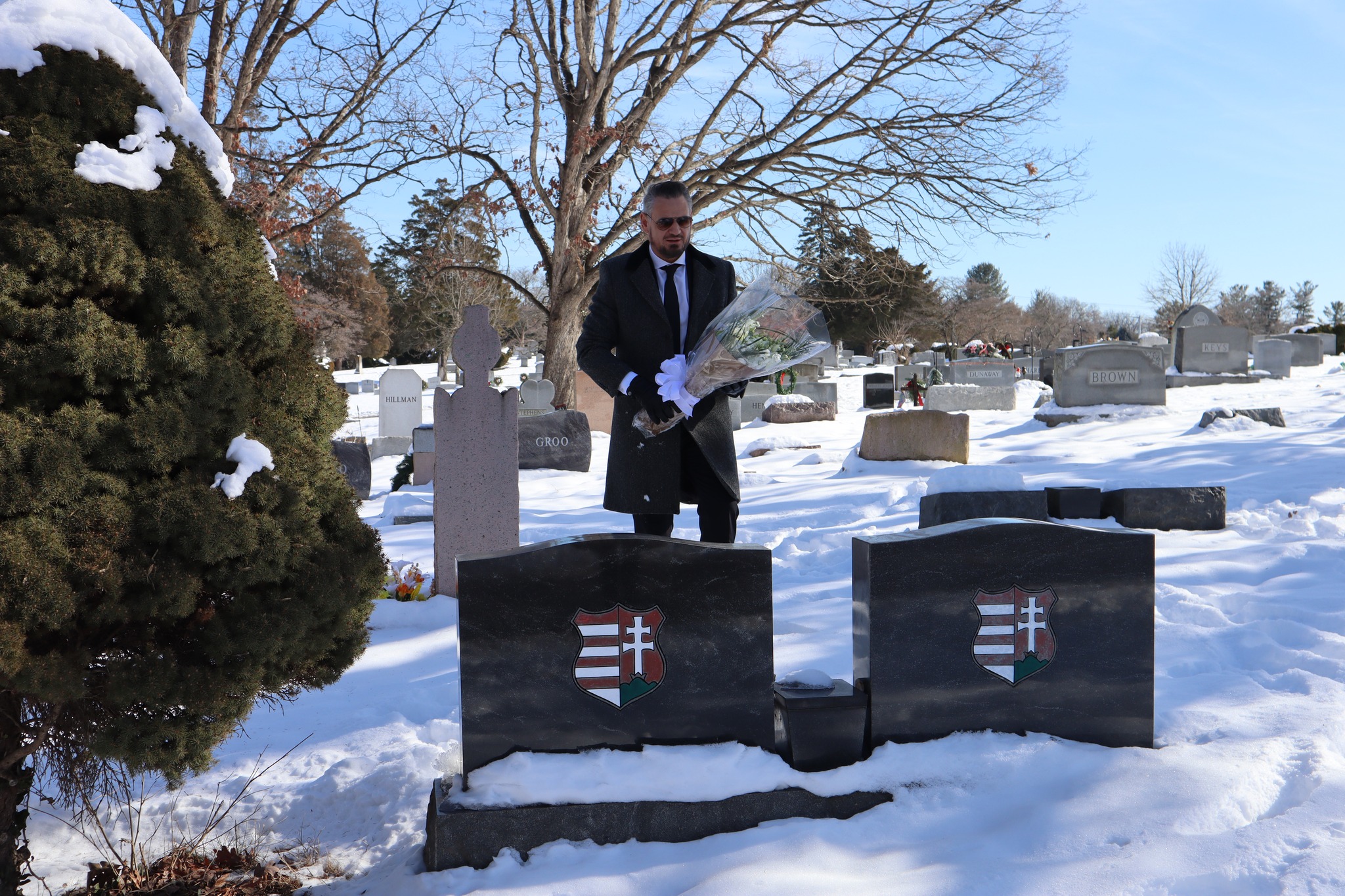
His Excellency Ambassador Szabolcs Takács visited the gravesite of Prime Minister Ferenc Nagy and his wife, Julianna Nagy, and laid flowers
2024.01.22.
“His Excellency Ambassador Szabolcs Takács visited and laid flowers at the grave of Prime Minister Ferenc Nagy and his wife, Julianna Nagy, in Herndon, Virginia, on January 22, 2023. Ferenc Nagy was the only freely elected prime minister of the Second Hungarian Republic, which existed from 1945 to 1948, and served as president of the Independent Smallholders’ Party.”
Közterület (PécsTV)
Missing Pieces from the Life Story of Prime Minister Ferenc Nagy
2023.10.20.
On PécsTV’s program ‘Közterület,’ András Gerner’s guest was Zoltán Kovács, who spoke about the significance of Ferenc Nagy’s life’s journey and his latest documentary film about him.
Pécsi Kör (Pannon Television)
Former Prime Minister Ferenc Nagy was born 120 years ago: A research group held a memorial ceremony in Bisse
2023.10.18.
On ‘Pécsi Kör,’ a cultural program on Pannon Television, Zoltán Ginelli spoke about the research group’s work, the significance of the commemoration held in Bissén, and how Ferenc Nagy’s life story helps paint a picture of Hungary’s global history.
New volume on Ferenc Nagy
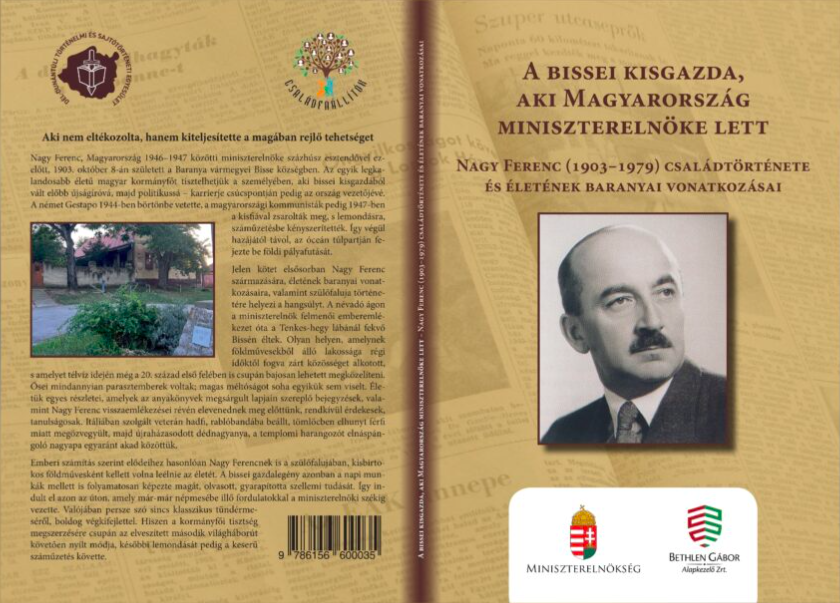
‘The Smallholder from Bise Who Became Prime Minister of Hungary: The Family History of Ferenc Nagy (1903–1979) and the Baranya Aspects of His Life’South Transdanubian Association for History and the History of Journalism
2023.10.07.
“Our association’s latest publication on local history has been released, focusing on the aspects of the life of Ferenc Nagy—who served as Prime Minister of Hungary from 1946 to 1947—that are connected to Baranya County. (...) The authors of the volume are: Krisztián Szalánczi (historian), Zoltán Kiss (librarian), and Ákos Farkas (political scientist). The members of the Prime Minister Ferenc Nagy Research Group, as well as the staff of the Családfaállítók company, provided invaluable professional assistance in the preparation of this publication, and we would like to take this opportunity to thank them for their contribution!”
A Farmer from Bisse: Ferenc Nagy as a Journalist
‘Snapshots from the Local History of Baranya County’ Conference South Transdanubian Association for History and the History of Journalism
2022.11.07.
Zoltán Kiss, a librarian and member of our research group, gave a presentation on the journalistic career of Ferenc Nagy at a local history conference titled “Snapshots from the Local History of Baranya County (II.),” organized by the South Transdanubian Historical and Press History Association in Pécs: “ In the 20th century, in the era before television and the internet, political journalism was one of the main avenues for becoming a well-known politician. The first reports about Ferenc Nagy appeared in the Transdanubian region; later, he wrote regularly for the ‘Kisgazdák Lapja’ [Smallholders’ Paper]. He gained national recognition through his articles in the ‘Pesti Hírlap’ [Pest Newspaper]. The newspaper ‘Magyarföld’ [Hungarian Land] served as the platform for the intellectual groundwork leading to the formation of the Independent Smallholders’ Party in late 1929 and throughout 1930. Between 1931 and 1942, ‘Független Kisgazda’ [Independent Smallholder] could already be considered the party’s mouthpiece. In 1944, he served as editor-in-chief and publisher of ‘Kisgazdaság’ [Small Economy]. In 1945—until his appointment as minister—he was editor-in-chief of ‘Kis Újság’ [Small Newspaper]. He was the author of numerous outstanding journalistic pieces. He often signed his articles as follows: “Ferenc Nagy, smallholder from Bisse.”
Szabad Pécs
He was one of the Hungarian prime ministers who led the most eventful life, but after going into exile, he was never able to return home
Attila Babos
2021.12.18.
“Zoltán Kovács believes that Ferenc Nagy deserves to be elevated to a new level in Hungarian historiography and collective memory. The former Hungarian prime minister’s archival collection, preserved in the U.S., can help achieve this: these memoirs, articles, photos, films, and audio recordings have been waiting for more than four decades—first for digital preservation, and then for scholarly analysis. Ferenc Nagy also played a role in the repatriation of the Hungarian crown and crown jewels in 1979. Prior to that, a young senator participated in the U.S. congressional hearing—a man who has since become one of the world’s most well-known politicians: Joe Biden, the current President of the United States.”
444.hu
How could one tell the story of Hungary's history without viewing it from a Western perspective?
Bence Horváth
2021.05.24.
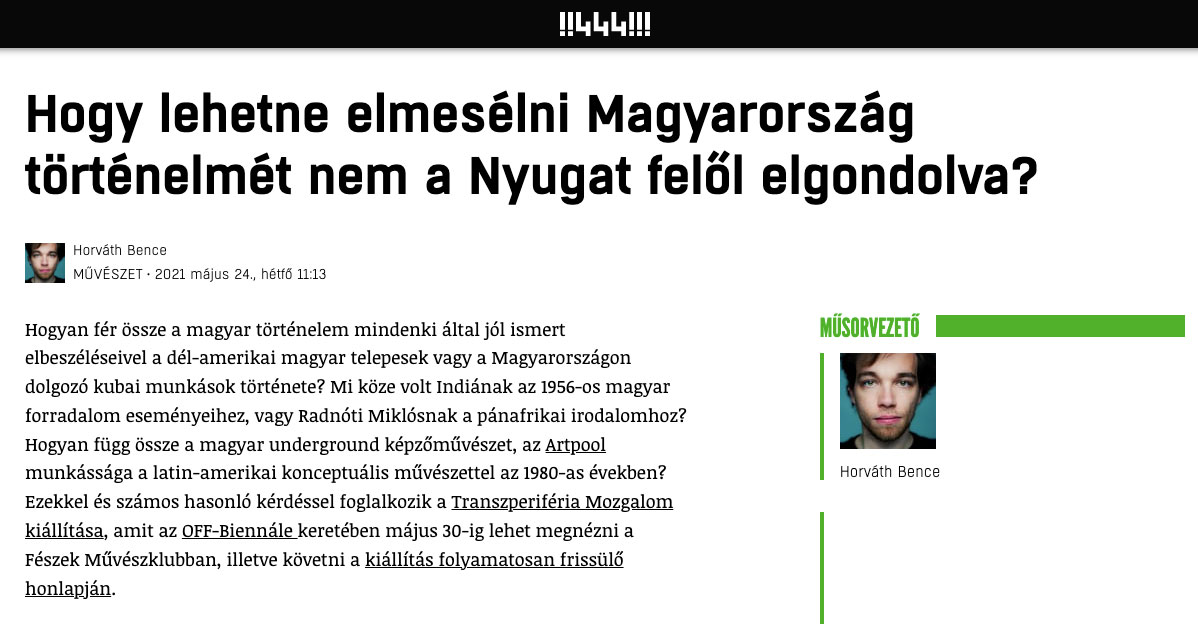
The 444.hu news portal conducted an interview with the head of our research group, Zoltán Ginelli, about the exhibition he co-curated, titled “Transperiphery Movement: Global Eastern Europe and the Global South.” Excerpt from the interview: “As Ginelli explained, Ferenc Nagy took part in tours organized by the CIA in South Asia, where he spoke to local politicians, diplomats, and the general public about ‘Soviet colonialism.’ During this period, the Americans deliberately deployed Eastern European émigrés in developing countries to promote U.S. foreign policy interests as authentic critics of the Soviet Union. In 1955, the first major Afro-Asian postcolonial conference was held in Bandung, Indonesia, which later led to the formation of the “Non-Aligned” Third World, and—as Ginelli’s research shows—Ferenc Nagy played an integral role in ensuring that the issue of Soviet colonialism was placed on the agenda there, holding discussions with, among others, Indian Prime Minister Jawaharlal Nehru.”
Poliko Podcast
The Transperiphery Movement Exhibition: Towards a Global History of Peripheral Connections with Zoltán Ginelli
Dávid Karas
2021.04.24.
On Poliko’s English-language podcast on political economy, host Dávid Karas spoke with one of the leaders of our research group, Zoltán Ginelli, about the exhibition titled “The Transperiphery Movement: Global Eastern Europe and the Global South.” The conversation also touches on Ferenc Nagy and the globalization of the Hungarian folk movement.
2021 OFF-Biennial Budapest: Inhale!
Transperiphery Movement: Global Eastern Europe and Global South
Art and documentary exhibition
Zoltán Ginelli & Eszter Szakács
2021.04.23. – 2021.05.30.
As part of the research into the life of Ferenc Nagy, the art and research exhibition titled “Transperipheria Movement: Global Eastern Europe and the Global South”—curated by the head of our research group, Zoltán Ginelli, and Eszter Szakács—was featured in the episode Peripheral Networks: Anti-Communists. The theme of the exhibition was as follows: “Can Hungarian settlers in South America, Cuban guest workers in Hungary, and Afro-Asian students studying in Eastern Europe share a common history? Can we speak of a shared colonial history between Eastern Europe and the Global South? Through the concepts of colonialism, peripheral status, and migration, the exhibition explores the historical connections and parallels between the global periphery (the Global South) and the semi-periphery (Eastern Europe) in the 20th century.”
Exhibition website: transperiphery.com

Pannon TV Pécs: ‘Ismerős’
Biographical Research: Ferenc Nagy (1903–1979), the Smallholder Prime Minister
2021.04.16.
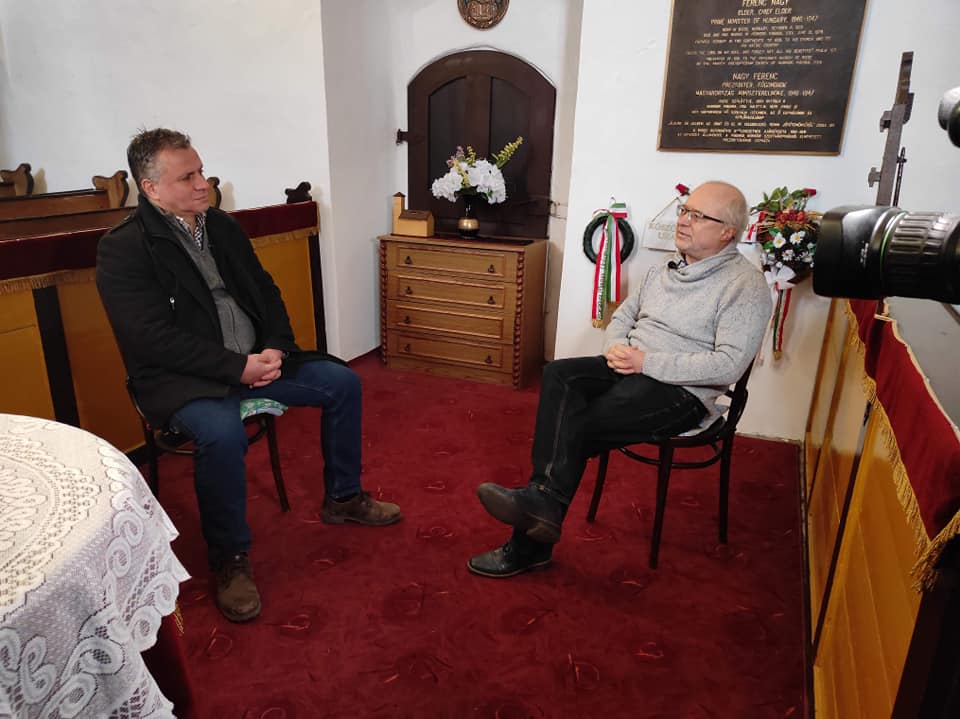
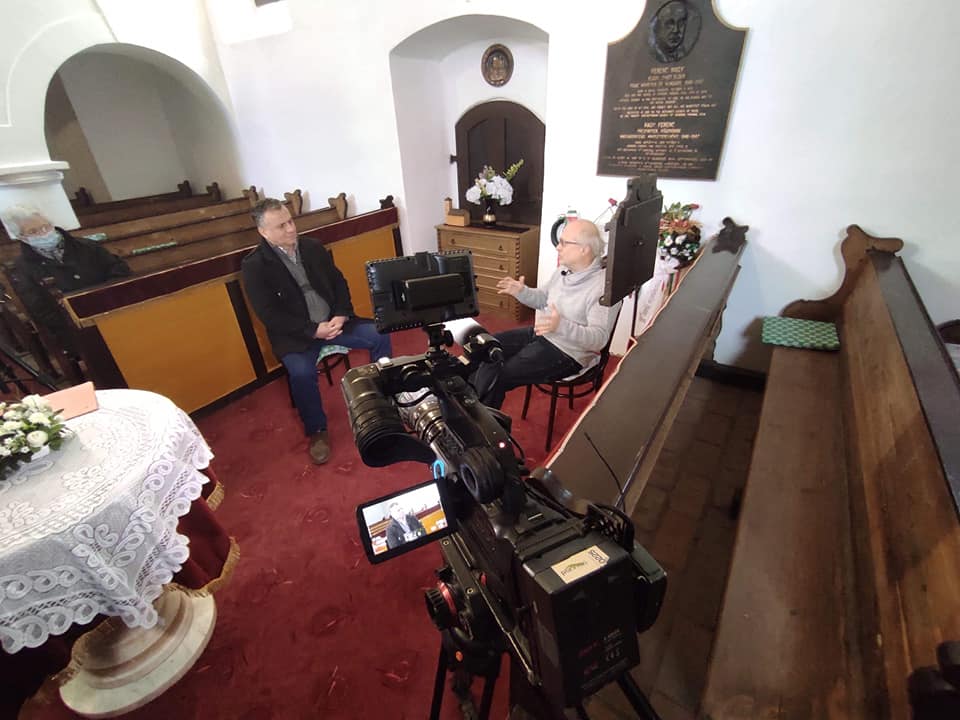
Zénó Slajchó spoke with Zoltán Kovács, one of the leaders of our research group, about our research into the life of Ferenc Nagy on the Pannon TV program ‘Ismerős’ in Pécs.
Editor: Zénó Slajchó
Cameramen: István Viszti and Gábor Tamás
Location: Bisse, Reformed Church (March 24, 2021)

Pannon TV Pécs: News
Tourist attraction in Bisse?
2021.04.02.
“The birthplace of Ferenc Nagy in Bisse, Baranya County. This is where the former farmer-turned-prime minister lived and hailed from; after the communist takeover, he was forced to emigrate to the United States. Based on a proposal, his birthplace in Bisse could now become a tourist attraction. (...) Former radio journalist Zoltán Kovács is researching the life and work of Ferenc Nagy. This tourist attraction, which would also include Bisse, would be developed based on his idea.”
Pannon TV Pécs: News
Research Institute
2021.03.24.
“A journalist from Pécs [Zoltán Kovács], who is researching the life and work of the former smallholder-turned-prime minister, does not rule out the possibility of establishing an institute. (...) The researcher says that this period of our history has not yet been fully documented. One example of this is Ferenc Nagy, whose notes—numbering several thousand pages—are stored in boxes in the United States.”
➝ YouTube
Szabad Pécs
Prime Minister Reflects on the Past in Baranya: Ferenc Nagy Was Appointed 75 Years Ago
Attila Babos
2021.02.04.
“Seventy-five years ago today, Ferenc Nagy—who was born and raised in Bissén, Baranya County—was appointed prime minister. The small-scale farmer-turned-politician served as Hungary’s prime minister from February 4, 1946, to May 31, 1947, during one of the most difficult periods in Hungarian history. On the anniversary, Szabad Pécs spoke with Zoltán Kovács, a freelance journalist and researcher specializing in this topic and the life of Ferenc Nagy. The question also arose as to what Joe Biden, the new U.S. president, might do to accelerate the research in Pécs.”
Association for Slavic, East European, & Eurasian Studies 52nd Annual Convention in 2020
‘The Clash of Colonialisms: The Race of Hungarian Communist and Anti-Communist Anti-Colonialisms in the Third World’
Zoltán Ginelli
2020.11.06.
One of the leaders of our research group, Zoltán Ginelli, gave a presentation at the annual conference of the Association for Slavic, East European, and Eurasian Studies (ASEEES), a prominent American academic organization (November 5–8 and 14–15, 2020). His presentation, delivered in the session titled “Hungary, (Anti)Colonialism, and the Global Cold War,” presented the findings of his research on the life of Ferenc Nagy. A summary of the presentation: “Ez az előadás azt vizsgálja, hogy a vasfüggöny két ellenoldalán élő magyarok hogyan nyitottak az afroázsiai dekolonizáció felé kelet-európai félperifériás pozíciójukból a Harmadik világgal közösséget kereső, mégis egymással versengő gyarmati érveikkel. Az államszocialista Magyarország a szocialista globalizáción keresztül igyekezett nyitni a nyugati protekcionizmus ellen, amely nyomán a nyugati imperializmussal szembeni antikolonializmust és szolidaritást képviselt a felszabaduló gyarmatok irányába. A tét óriási volt, ugyanis a magyar antikommunista politikai menekültek nyugaton már arra törekedtek, hogy ők előbb alakítsanak ki antikolonalista szolidaritást a posztkoloniális országok felé, akiket a "szovjet gyarmatosítás" ellen igyekeztek fordítani.”
"Centuries of Pécs-Baranya" Conference
6. Portrait Sketches: The 40th Anniversary of the Death of Prime Minister Ferenc NagyGyőző Csorba Library, Pécs
2019.11.15.
10.20 Zoltán Kiss – From Bisse to Herndon: Snapshots from the Life of Prime Minister Ferenc Nagy
10.40 József Bodonyi – Character Assassination and Rehabilitation: The Rehabilitation of Prime Minister Ferenc Nagy in the Digitized Collective Memory
11.20 Zoltán Kovács – Facts and Secrets (Part 1)
A documentary film about the life of Prime Minister Ferenc Nagy (1903–1979)
Editor: Zoltán Kovács, cameraman: Richárd Kovács
➝ Full programme
Historical justice for Ferenc Nagy (FKgP), born in Bisse, who served as prime minister in 1946–47!
Remarks by independent MP Dr. István Apáti in the Hungarian Parliament
2019.07.12.
“The life of the late Prime Minister Ferenc Nagy is replete with extraordinary twists and turns—events worthy of American adventure, historical, and spy films—but please allow me, due to time constraints, to highlight only a few key milestones and moments from his life, thereby bringing before this House and highlighting the astonishing historical and political failure, for which the past thirty years bear the decisive responsibility. (...) his childhood home in Bise should be designated a memorial house; a statue should be erected in memory of the late prime minister; he should be given his rightful place in history education; and the Ministry of Foreign Affairs should take all necessary measures to establish contact with and maintain regular communication with his relatives living in the United States. Thank you very much for your attention.”
Hirado.hu
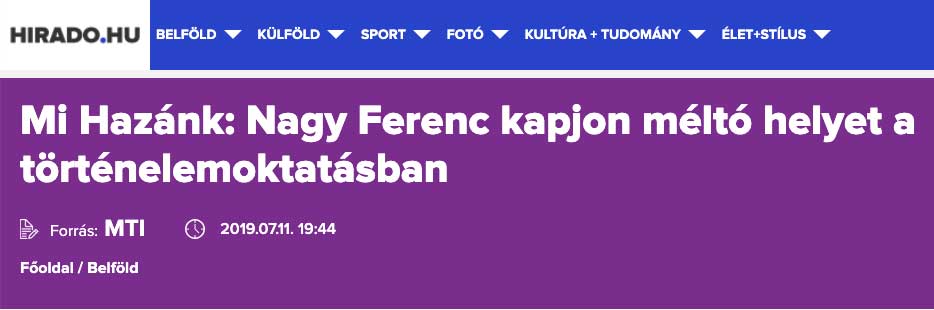
Our Homeland [party]: Ferenc Nagy Deserves a Rightful Place in History Education
2019.07.11.
“István Apáti, an independent member of the National Assembly, stated that they are also demanding that the birthplace of the smallholder politician in Bisse, Baranya County, be designated a memorial house and renovated, and that a statue be erected in honor of the first prime minister of the Second Hungarian Republic. Furthermore, they are asking the government to ensure that Ferenc Nagy is given a fitting place in history education, and that the Ministry of Foreign Affairs contact his relatives living in the United States,” he added.”
Népszava
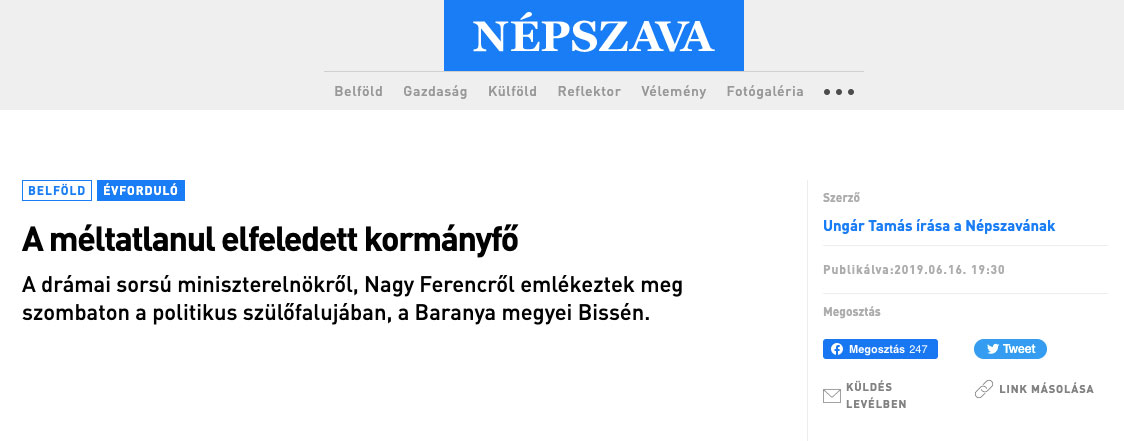
The Unjustly Forgotten Head of Government
Tamás Ungár
2019.06.16.
“On Saturday, residents commemorated Ferenc Nagy, the prime minister whose life took a dramatic turn, in his hometown of Biss, Baranya County. (...) Zoltán Kovács, a journalist and consultant for the local history collection at the Győző Csorba Library in Pécs, attended Saturday’s ceremony and said that he will travel to the United States in September, where he will attempt to gather the documents left behind by Ferenc Nagy. He will meet with the prime minister’s twin daughters, who were born in Herndon, as well as several of his grandchildren and great-grandchildren. He will compile a collection of materials from these conversations, which could serve as the basis for a film about Ferenc Nagy.”
Commemorative Exhibition on Prime Minister Ferenc Nagy (1946–1947)
Győző Csorba Library
2013.06.06.
“Sixty years later, the letter of resignation that Prime Minister Ferenc Nagy, a native of Bise, wrote in 1947 from Switzerland to President Zoltán Tildy was discovered in the Archives of the Office of the President of the Republic. A copy of the original handwritten letter—now considered of historical value—along with other biographical photos, articles, studies, reports, and a documentary film, can be viewed in the virtual exhibition available at the link below; and in person at the South Transdanubian Regional Library and Knowledge Center in Pécs—in the Local History Collection on the first floor of the Győző Csorba Library.”
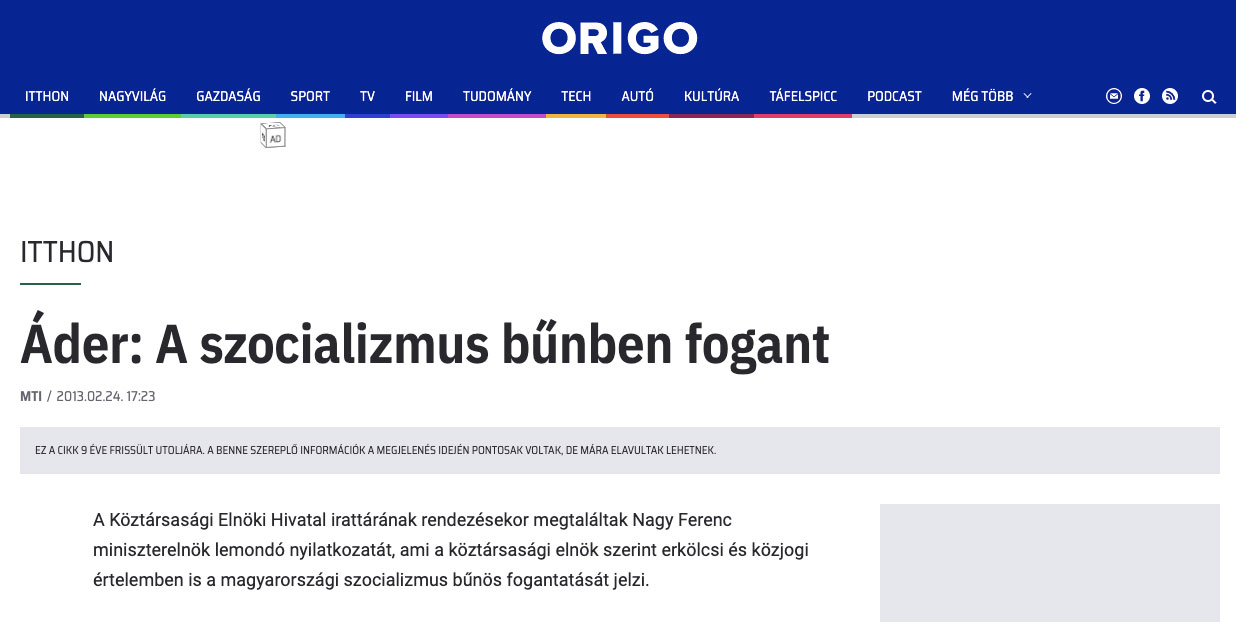
Origo.hu
Áder: Socialism Was Conceived in Sin
2013.02.24.
“While organizing the archives of the Office of the President of the Republic, they found Prime Minister Ferenc Nagy’s resignation statement, which, according to the President of the Republic, signifies—both morally and in terms of public law—the sinful conception of socialism in Hungary. (...) Áder stated that while organizing the archives of the Office of the President of the Republic (KEH), they came across the resignation statement of former Prime Minister Ferenc Nagy, which was forced upon him in 1947. According to the President, this document—known to historians but previously believed to be lost—reveals that, in its thirst for power, the Communist Party could not even wait for the sitting prime minister to resign, as the Dinnyés government was sworn in before Ferenc Nagy’s resignation on June 1, 1947.”